Glyco Harmony Official Website › Blog › Glyco Harmony formula and ingredients
Glyco Harmony Formula and Ingredients: The 7.6 mg Blend Question
Most readers look at the length of an ingredient list. The more useful number is the weight at the bottom of it. For Glyco Harmony that number is 7.6 mg, and it changes how everything above it should be read.
Quick answer: The Glyco Harmony panel text lists chromium as chromium picolinate at 200 mcg, then a 7.6 mg proprietary blend naming 18 ingredients in descending order by weight. Amounts inside the blend are not published. The base is vegetable glycerin, purified water, lemon, stevia, xylitol and natural flavours.
- Chromium (as chromium picolinate): 200 mcg. It is the only published amount.
- Proprietary blend: 7.6 mg in total, naming 18 ingredients in descending order by weight. No individual amount is published.
- US labelling rules (21 CFR 101.36) allow a blend to be declared by total weight alone.
- Studied doses for several blend ingredients are in the hundreds of milligrams, or grams. All exceed the whole blend.
- Base: vegetable glycerin and purified water, with lemon, stevia, xylitol and natural flavours. No gluten, no lactose. Trace caffeine.
General information, not medical advice. Glyco Harmony is a dietary supplement. It is not FDA approved, and no supplement is. It is not meant to diagnose, treat, cure or prevent any disease. If you have a medical condition or take medicine, ask your doctor or pharmacist before you use it.
What is on the Glyco Harmony supplement facts panel?
Per 1 ml serving, the seller's published panel reads as follows. The bottle is 2 fl oz (60 ml) and holds 60 servings.
People search for the “glyco harmony formula”, “glyco harmony ingredients”, “glyco harmony ingredients list”, “ingredients in glyco harmony”, “glyco harmony drops ingredients”, “glyco harmony supplement facts”, “glyco harmony label”. For other products, the same question comes up as blood sugar support ingredients.
| Line | Amount per serving |
|---|---|
| Chromium (as chromium picolinate) | 200 mcg |
| Proprietary blend | 7.6 mg |
| Inside the blend | Amount not disclosed for any ingredient |
| Daily Value | Not established for the blend |
Confirm it against the panel on your own bottle. The bottle is the authority, not this page, and we say so because the label artwork shown on this website's home page prints different figures, such as a different chromium amount, a different blend weight and a longer list of names. If your bottle differs from this page, call +1 (925) 231-0148 and ask which version you hold.
Which 18 ingredients are in the blend?
The names are listed in descending order by weight, so the first ones weigh the most. How much more is not published.
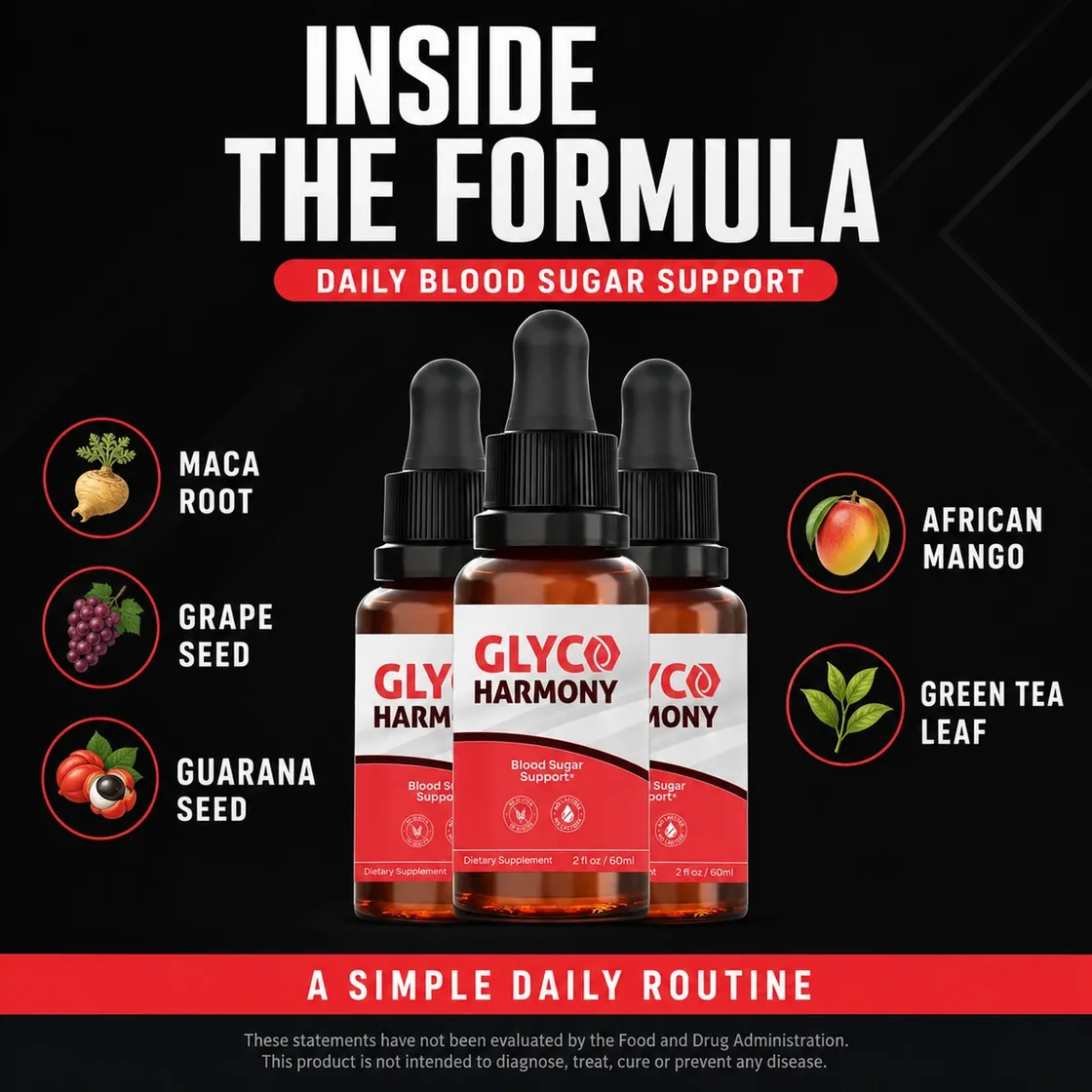
Maca root extract, grape seed extract, guarana seed extract, African mango seed extract, eleuthero root extract, astragalus root extract, green tea leaf extract, gymnema leaf extract, coleus forskohlii root extract, capsicum fruit extract, grapefruit, raspberry ketones, L-glutamine, L-tyrosine, L-arginine, beta-alanine, GABA and tryptophan.
Two things follow from that order. The first names probably weigh more than the last. And a name on the list is not the same as a studied dose of that ingredient.
Why does the 7.6 mg total matter so much?
A milligram is a very small weight. The whole blend is 7.6 mg. If it were split evenly across 18 names, each would get about 0.42 mg. The real split is not even, and it is not published, but the picture holds: each name gets a sliver.
Compare that with the doses used in the research the seller cites on its ingredients page.
| Ingredient | Dose used in research, per the seller's page | Against the whole 7.6 mg blend |
|---|---|---|
| Gymnema leaf | Hundreds of milligrams a day | Far larger |
| African mango seed | 300 mg a day (one trial) | About 39 times the whole blend |
| Coleus forskohlii | 500 mg a day of standardised extract | About 66 times the whole blend |
| Grape seed (with bilberry) | 300 mg for twelve weeks (one trial) | About 39 times the whole blend |
| Beta-alanine | Grams a day (4 to 6 g in trials) | More than 500 times the whole blend |
The seller makes the same point on its own pages and says the botanicals are on the label as a nod to the research, not as a delivery of it. We agree with that reading.
What does the chromium line tell you?
Chromium is the one line with a number you can compare against something. The seller says 200 mcg is a conventional supplemental dose and is well above the adequate intake of 25 to 35 mcg a day for adults. That is roughly six to eight times the intake figure it quotes.
The form is chromium picolinate, which the seller says is the form behind much of the research it cites. The research effects are small, and the seller notes that people who already get enough chromium from food have less to gain. See our chromium article for the full discussion.
What is in the base, and what is not?
- Base: vegetable glycerin and purified water, with lemon, stevia, xylitol and natural flavours.
- Not in it: gluten and lactose. The seller says it is vegetarian-suitable.
- Caffeine: a trace, from guarana seed and green tea leaf.
- Calories and other nutrients: not published in the material we hold.
The glycerin base is also why you should shake the bottle. The extracts settle, and a few seconds of shaking before each serving keeps the serving even.
What can the certificate check, and what can it not?
The certificate on file, GH-COA-3304-26Q3, comes from Empire Chromium Analytics in New York. It covers chromium identity and a microbial screen. It cannot confirm the blend, because nothing was ever disclosed to test against.
That is not a flaw in the lab. It is a limit of proprietary blends in general, and the seller says the same is true of every product that uses one.
What questions should you ask the seller about the formula?
A good buyer asks. The order desk is on +1 (925) 231-0148. These are fair questions, and the answers are not published today.
- What is the amount of each ingredient inside the 7.6 mg blend?
- Who manufactures the product, and where is the facility?
- Does the certificate cover the blend, now or in any future lot?
- Which panel is current: the one shown on this website or the one on my bottle?
- Is there any study of the finished formula?
If the answers are "not disclosed", at least you will have asked.
Frequently asked questions
What are the ingredients in Glyco Harmony?
Chromium (as chromium picolinate) at 200 mcg, plus a 7.6 mg blend naming 18 botanical extracts and amino acids. The base is vegetable glycerin, purified water, lemon, stevia, xylitol and natural flavours.
How much of each blend ingredient does one serving hold?
Not published. US labelling rules allow a blend to be declared by total weight. The total is 7.6 mg, and no one outside the manufacturer can give the split.
Is the formula tested?
Lot GH.26.Q3.NY.3304 is documented under certificate GH-COA-3304-26Q3. It covers chromium identity and a microbial screen. It does not quantify the blend.
Does Glyco Harmony contain caffeine?
A little. Guarana seed and green tea leaf both add caffeine, but the seller calls the amount tiny and gives no exact figure.
Is there research on the Glyco Harmony formula?
The finished formula has no published trial behind it. The research the seller cites is on individual ingredients, often at larger doses than the whole blend contains.
What if my bottle's label differs from this page?
Trust the bottle and call the order desk on +1 (925) 231-0148. The label artwork shown on this website's home page prints different figures, and we cannot settle that from here.
Our view
The panel is short, and one line carries it. Chromium at 200 mcg is a real, checkable dose. The 18 names in the 7.6 mg blend are not, and the seller says so more bluntly than most do.
That honesty is the best thing about this label. It lets you do the arithmetic yourself. Our view is that you should buy this product, if you do, for the chromium and the habit, and treat the blend as a bonus of unknown size.
If you want to check the panel before you pay, the order page shows the product and the terms. If you take medicine, take the label to your pharmacist.
Last updated